
Is a $400 Multimeter Actually Better Than a $100 One?
The difference isn't accuracy. It's what happens the one time you're wrong about which wire is hot.
By Tom Reyes · September 5, 2026
Every meter on the shelf reads volts, ohms, and continuity. A $20 meter from the hardware store and a $250 Fluke will both tell you a circuit is dead. So why do working electricians pay ten times more for one over the other? Two reasons, and neither of them is "accuracy": CAT rating, and True RMS.
CAT rating is not a spec sheet number, it's a body count
CAT (Category) ratings, set by the IEC, describe how much transient overvoltage a meter can absorb without the probes exploding in your hand. CAT III covers fixed wiring in buildings, distribution panels, and branch circuits. CAT IV covers the origin of the service, like a utility meter or an outdoor transformer, where a fault can dump a much bigger transient into the meter. Both ratings assume the same internal impedance; CAT IV meters just have heavier internal protection to survive a bigger spike.
A cheap meter with no real CAT rating, or a CAT II rating meant for household outlets, isn't dangerous on a dead circuit. It's dangerous on the one circuit that wasn't actually dead, or the one panel with a fault waiting behind the cover. That's the entire reason to spend more: not for a better number on a clean reading, but for what happens on the one bad one.
What this means for you
If you only ever test low-voltage branch circuits after the panel is already confirmed dead, a CAT II/III meter is genuinely fine. If you're opening panels, working near services, or doing anything where you don't fully control what's live, the CAT rating is the one spec worth paying for.
True RMS matters more than most apprentices realize
A basic "average responding" meter assumes the AC waveform is a clean sine wave and does simple math to estimate voltage. That assumption breaks down on anything with a variable-frequency drive, a dimmer, an LED driver, or modern electronics on the load side, all of which distort the waveform. A True RMS meter samples the actual waveform many times per cycle and calculates the real effective value, sine or not. On a clean sine wave, the two meters agree. On the increasingly common non-sinusoidal loads in a modern building or shop, they can disagree by enough to send you chasing a problem that isn't there, or missing one that is.
| Basic meter | True RMS meter | |
|---|---|---|
| Clean sine wave (most household circuits) | Accurate | Accurate |
| VFDs, dimmers, LED drivers, motor drives | Can be off by a meaningful margin | Accurate |
| Typical CAT rating | CAT II or unrated | CAT III / CAT IV available |
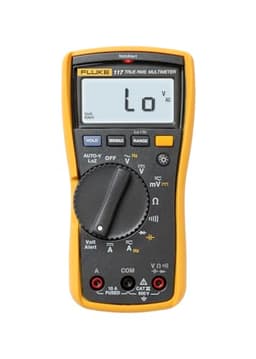
Fluke 117 Digital Multimeter
BestTrue-RMS multimeter with non-contact voltage detection, built for daily commercial/residential electrical work.
$239.32
View on Amazon
That's a CAT III meter with True RMS and non-contact voltage detection built in. It's not cheap, but it's also not the top of Fluke's line; it's the one most working residential/commercial electricians actually carry.
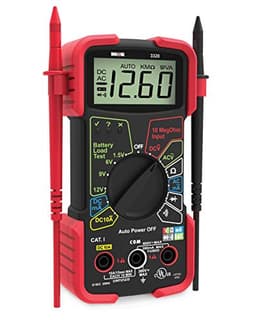
INNOVA 3320 Auto-Ranging Digital Multimeter
Covers the basics (voltage, resistance, continuity) at a fraction of the cost of a professional-grade meter.
$35.38
View on Amazon
For a hobbyist, an apprentice on a tight budget who's mostly testing dead circuits under supervision, or a home shop where the loads are simple, a basic meter like this is a legitimate choice. It isn't a downgrade for what most people actually use it for; it's just not rated for the situations where the expensive one earns its price.
The honest answer
A $400 meter isn't better at reading a clean 120V outlet than a $100 one; they'll both nail it. It's better at the specific job of surviving a mistake and reading correctly on the loads a basic meter gets confidently wrong. If your work never puts you near that scenario, save the money. If it does even occasionally, this is one of the few tools where the expensive option isn't marketing, it's the thing standing between you and a very bad day.
Related reading

Why More HVAC Techs Are Charging by Weight Again
Superheat and subcooling tell you if a charge is right. A scale is how you get it right the first time, without guessing your way there.
By Tom Reyes

Cordless Finally Caught Up to Pneumatic
Brushless motors and high-output batteries closed most of the gap. They didn't close all of it, and the part that's left matters if you're on your feet all day.
By Tom Reyes